The Attention Economy
First Presbyterian Church of St. Petersburg · 701 Beach Dr NE, St. Petersburg, FL 33701
Scripture Readings (NRSV)
11When Israel was a child, I loved him, and out of Egypt I called my son. 2 The more I called them, the more they went from me; they kept sacrificing to the Baals, and offering incense to idols. 3 Yet it was I who taught Ephraim to walk, I took them up in my arms; but they did not know that I healed them. 4 I led them with cords of human kindness, with bands of love. I was to them like those who lift infants to their cheeks. I bent down to them and fed them. 5 They shall return to the land of Egypt, and Assyria shall be their king, because they have refused to return to me. 6 The sword rages in their cities, it consumes their oracle-priests, and devours because of their schemes. 7 My people are bent on turning away from me. To the Most High they call, but he does not raise them up at all.
8 How can I give you up, Ephraim? How can I hand you over, O Israel? How can I make you like Admah? How can I treat you like Zeboiim? My heart recoils within me; my compassion grows warm and tender. 9 I will not execute my fierce anger; I will not again destroy Ephraim; for I am God and no mortal, the Holy One in your midst, and I will not come in wrath. 10 They shall go after the Lord, who roars like a lion; when he roars, his children shall come trembling from the west. 11 They shall come trembling like birds from Egypt, and like doves from the land of Assyria; and I will return them to their homes, says the Lord.
13 Someone in the crowd said to him, "Teacher, tell my brother to divide the family inheritance with me." 14 But he said to him, "Friend, who set me to be a judge or arbitrator over you?" 15 And he said to them, "Take care! Be on your guard against all kinds of greed; for one's life does not consist in the abundance of possessions." 16 Then he told them a parable: "The land of a rich man produced abundantly. 17 And he thought to himself, 'What should I do, for I have no place to store my crops?' 18 Then he said, 'I will do this: I will pull down my barns and build larger ones, and there I will store all my grain and my goods. 19 And I will say to my soul, 'Soul, you have ample goods laid up for many years; relax, eat, drink, be merry.' 20 But God said to him, 'You fool! This very night your life is being demanded of you. And the things you have prepared, whose will they be?' 21 So it is with those who store up treasures for themselves but are not rich toward God."
22 He said to his disciples, "Therefore I tell you, do not worry about your life, what you will eat, or about your body, what you will wear. 23 For life is more than food, and the body more than clothing. 24 Consider the ravens: they neither sow nor reap, they have neither storehouse nor barn, and yet God feeds them. Of how much more value are you than the birds! 34 For where your treasure is, there your heart will be also.
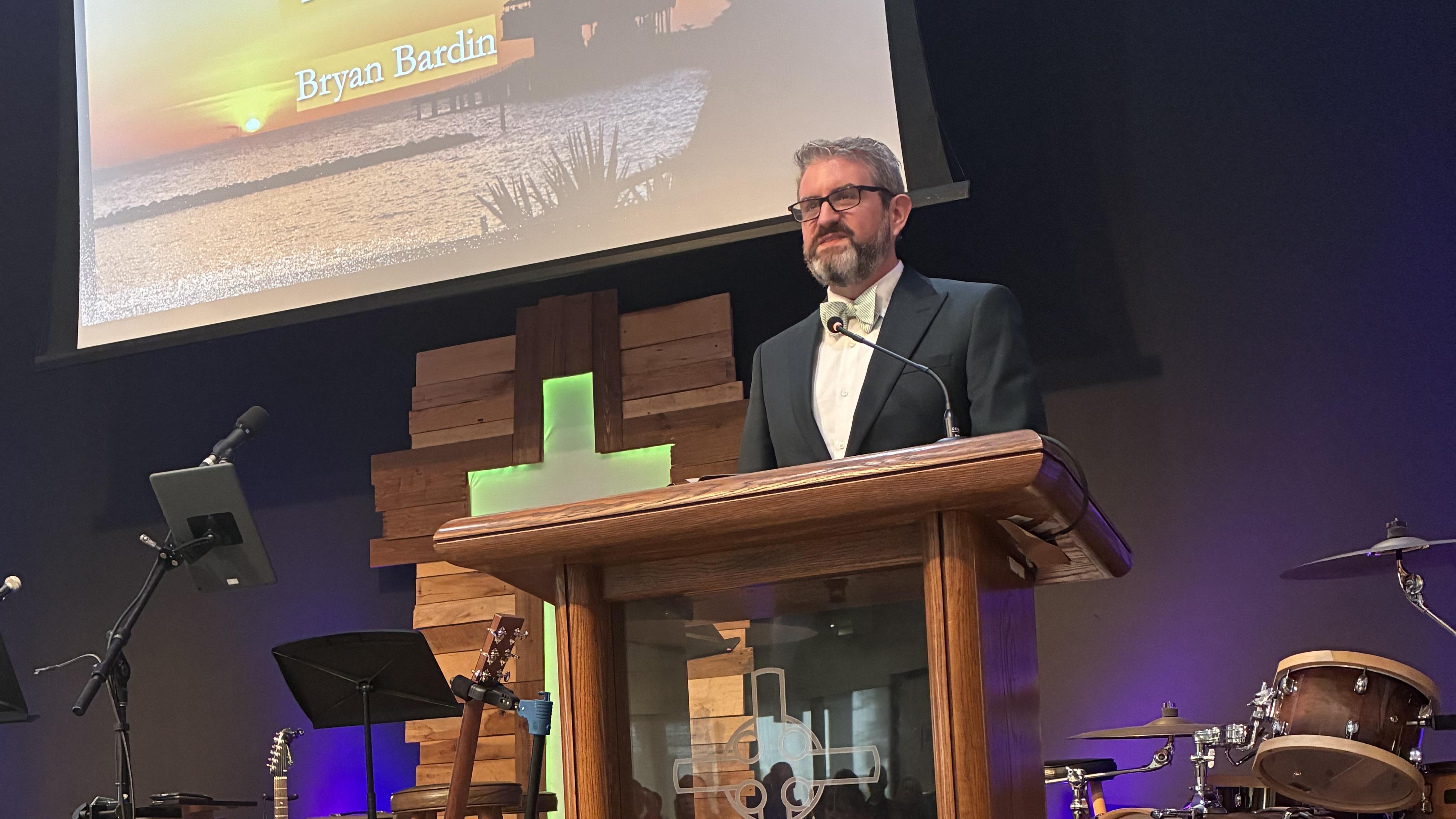
Good morning, church. For those of you who don't know me yet, my name is Bryan Bardin—I'm a fourth generation member of this congregation. By day, I work for Seacoast Bank as a strategic Program Manager, lately leading bank acquisitions.
And by night, I do a lot of different things, including participating in the life of this congregation. Most Sundays you can find me in the tech booth at the 9am service, helping with technical production. I am an active member of the NEXT Sunday School class. And I recently served as co-chair of the Pastor Nominating Committee that recommended calling Pastor Robert to our church.
If we roll the clock back, I spent about seven years as the Director of Christian Education at a Presbyterian Church in Westchester County, New York. In that role, I led worship a few times each year.
When I allowed myself to be talked into leading worship today, there was a part of me that thought I would pull out a sermon I wrote back then, freshen it up, and share it with you all.
But for those of you who know me well, you know how unlikely that actually was. If it's worth doing, it's worth over doing, or at least doing right—even if to my detriment.
So out of curiosity, I turned to the Revised Common Lectionary. If you don't know what the Lectionary is, it is a three year tour of scripture that was originally published in the early 90s. Today the RCL is used by mainline protestant churches like ours as a backbone of worship, guiding scripture selection. Each Sunday through the three year cycle, there are four scripture passages, an Old Testament passage, a Psalm, a Gospel passage, and an Epistle passage, from the letters.
Today's lectionary begins with the Prophet Hosea—which, if you know, you know. Hosea is a tough prophecy. God is fed up. Yet in the middle, as in all the books of prophecy, there is a message of hope.
Then the passage from Luke admonishes The Rich Fool. Jesus once again calling for a life changing level of sacrifice from Jesus followers.
You know, maybe I should have polished off an old sermon about the Berlin Wall and how life with God calls us to break down barriers all around.
But here we are. On this journey together today. Holding the tension and complexity, the discomfort and wisdom of all that it is to be in right relationship with the Creator of the Universe.
Let's get messy.
[Luke 12:13-24, 34]
What are you paying attention to? Right now, I hope it's me.
But what about the soreness in your hip? What about that kid of yours, you know the one? What about that project at work? Or that problem you've been having at home?
What are you actually paying attention to right now?
And what would it take for you to turn your attention not just to me, but to your relationship with God? How are you best able to pay attention to God?
Are you able to pay attention to God when God calls to you in still, small voice in the middle of an ordinary day?
What about when God speaks to you using the voice of a trusted friend who offers you a hard truth, but the right advice, far beyond their own wisdom?
Or maybe you're best able to pay attention to God through God's creation, sitting by the Gulf, watching a sunset, or in solitude, in the woods, surrounded by a choir of cicadas.
What about through scripture, are you able to pay attention to God calling to you today when reading this ancient, human transcribed, divinely inspired text?
By reading these stories as a sacred text, truths are revealed to us. Truths about ourselves—as we read ourselves into the narratives, alternatively as the "good guys" and the "rich fools". Truths about God—as we explore how God has revealed Godself through the ages. And truths about our walk together as God's chosen people. Can you pay attention to God today, through these stories?
If I'm being really honest with you, sometimes I struggle to pay attention to God when I read the bible. I can lose track of God's calling today in the midst of my very human reading of these texts. I see some of the Truths God is revealing to me, but I also see the contradiction, and the complexity. I often lose the nuance of God's calling in the midst of the loudness of my reading.
But if we're paying attention, there are even truths in the contradictions.
The NEXT Sunday School class has been enjoying a series on the "Character of God" based on God's revelation to Moses on Mt. Sinai in the Book of Exodus.
"The Lord, the Lord, a God merciful and gracious, slow to anger, and abounding in steadfast love and faithfulness, keeping steadfast love for the thousandth generation, forgiving iniquity and transgression and sin, yet by no means clearing the guilty, but visiting the iniquity of the parents upon the children and the children's children, to the third and the fourth generation."
[Exodus 34:6-7]
What God has revealed here feels like a contradiction. God is Merciful and Gracious. Slow to Anger. Abounding in steadfast love. Yet God is also visiting iniquity to the third and fourth generation.
What are we to do with this revelation of God?
The Truth is, yes, God is all of that, and we, we are made in the image of God, and yes, sometimes even God has to pay attention to what God pays attention to.
Hosea
Let's look at that passage from Hosea.
In this passage, through Hosea's prophecy, God tells us exactly what God has paid attention to when it comes to God's relationship with God's chosen people, with Israel or Elohim.
In the beginning God attended to Israel as a Father (or maybe even a mother) would their son. During the time after the exodus from Egypt, God attended to Israel's every need.
Walter Brueggemann, the renowned theologian and biblical interpreter describes that period like this:
He taught the little child to walk; he carried the little child in his arms and attended to every fall, every scar, every scab, every wound, and every fear. The father supported the little child with embraces of love, held him close, stooped low to attend to him, and fed him. Thus the father has guarded and guaranteed the son when the son was a little vulnerable child. It is all a narrative of graciousness.
— [Walter Brueggemann]
And through the desert, I think you could fairly describe Israel's behavior as a son, maybe going through their terrible twos, to a father. Never intentionally cruel, but certainly missing the mark, repeatedly.
But soon, Israel isn't just a troublesome toddler. They have grown into a full blown teenage rebellion.
My people are bent on turning away from me. To the Most High they call, but he does not raise them up at all.
[Hosea 11:7]
God has had enough. Brueggemann writes:
(These verses of the poem) are a shrill rant, the kind a teenager can evoke from even the most caring father. The father is completely exhausted with the son and is willing to leave the son to the consequences of his choices. Israel is abandoned to its self-destruction, the kind in which any teenage son may find himself when the father acts in tough love.
— [Walter Brueggemann]
But then things get interesting.
After what Brueggemann describes as "a shrill rant" — God seems to pause and start paying attention to what God is paying attention to. Through this self-reflection, it's as though God is asking, "who am I?"
Is God slow to anger, abounding in steadfast love?
Or is God so fed up with the behavior of God's own chosen that he's ready for "(them to) return to the land of Egypt, and Assyria shall be their king, because they have refused to return to me."
The father comes to a fresh recognition of his own identity: "I am God." I am not simply a macho guy that emotes in destructiveness. I am the Holy One of whom more is expected and from whom more is promised. I, as Holy One, will turn ordinary rage into viable relationship.
— [Walter Brueggemann]
God longs for relationship with us. No matter what we are paying attention to, God is paying attention to us and imploring us to return our attention to God. And while time and time again, our attention wanders—like Israel we create Golden Calves in the desert, like the Prodigal Son we squander our inheritance on extravagance, or like the Rich Fool we put our faith in things.
Yet God is merciful and gracious, slow to anger, and abounding in steadfast love and faithfulness, keeping steadfast love for the thousandth generation.
[Exodus 34:6]
God is longing for us to pay attention to what we are paying attention to and come to a fresh recognition of our own identity. We are chosen by God. We are called to turn ordinary distraction and desire into viable relationship.
So what are we really paying attention to?
Luke
This passage in Luke is titled "The Rich Fool" — not the most flattering title.
It contains two stories, the first, a story of a second born son asking Jesus to settle a legal dispute over his inheritance.
This was common at the time—it was customary to bring a case like this to a religious leader. Ever since Moses' days, religious law governed both civil/criminal matters, as well as moral and ritualistic matters.
Jesus' refusal to settle this squabble speaks to the fact that Jesus has a task far greater than Moses.
Jesus wasn't sent to ARBITRATE between people with God, Jesus was sent to RECONCILE people with God.
Legal opinion can arbitrate a decision, settling a dispute, casting judgement. Jesus' calling of reconciliation is to be merciful and gracious, slow to anger, and abounding in steadfast love and faithfulness. Jesus implores us to all seek right relationship with God and others.
What is this younger son paying attention to? Is he paying attention to the fact that if the family's property stays together the whole family is stronger and better off, or is he paying attention to the short term gains that would come from cashing out his inheritance? If Jesus were to arbitrate in the younger son's favor, Jesus might be making the correct legalist decision, but he would be failing to reconcile this family into right relationship.
I know I can see myself in the position of that younger son. Feeling like things aren't always FAIR. Feeling like I'm somehow getting the short end of the stick.
Then, in the parable that follows, Jesus shows us exactly what happens when we start paying attention to the wrong things.
The Rich Fool is so fixated on his own will and way, he uses the possessive "my" five times.
My crops
My barns
My grains
My goods
MY SOUL
By not paying attention to what he's paying attention to, this Rich Fool completely missed the Truth. All that we have and all that we are belongs to God. "The Earth is the Lord's and everything in it, the world and all who live in it."
He misses the fact that HE didn't provide for himself, it was God's bounty from God's Earth that the man had collected.
The Rich Fool mistakenly believes that it was through self-determination that produced all his blessings.
The Rich Fool deludes himself into believing that he is self-sufficient in providing for his needs.
And in the end, The Rich Fool, so self-satisfied, believes that he has earned an abundant life through his collection of material things.
God is calling out, YEARNING for connection with us. And we are filling our barns with the grain of self-determination, self-sufficiency, and self-satisfaction.
As the passage concludes, Jesus does not bid disciples to be indifferent toward life. Jesus knows, and cares deeply that people have the material necessities for life, which is why we pray for daily bread. But Jesus is also aware of the tyranny of things. From Jesus' perspective, earthly treasure is a snare because it can lead us to invest our hearts in the material world and to rest on its false security rather than to find our true security in relationship with God.
Conclusion
In Jesus' time the economy was powered by goods. Grain, calves, cloth.
In our time, the economy is powered just as much by attention. Our attention is so profitable, two of the most valuable companies in the world, Google and Facebook, trade almost entirely on selling our attention to the highest bidder.
So how do you best pay attention to God? What does it look like for you to invest your attention in right relationship with the divine?
Because what God has revealed over and over in the scripture is that God is longing for connection with YOU. God's very soul aches for relationship with us. God desires to attend to us like a father attends to their son.
With what then are we filling our barns?
Are we filling our barns with the things that bring us closer in relationship to God? Or are we filling our barns with self-obsessed attention?
Have we put our faith in ourselves: our strength, our belongings, our 401ks, our current abilities? Or have we put our faith in relationship with a God who is merciful and gracious, slow to anger, and abounding in steadfast love and faithfulness. A God who is longing for us to turn our attention back on Him.
Where your treasure is, there will your heart be also.
[Luke 12:34]
And I believe the same is true for our attention.
Pay attention to what you pay attention to.
God so desires our attention. Can you find space in your life to pay attention to God?